How to Know When Your Ductwork Is Costing You Money
A duct system leaking 20 percent of conditioned air into an unconditioned Texas attic can add hundreds of dollars to a summer electricity bill.
August 26, 2026 · 2 min read
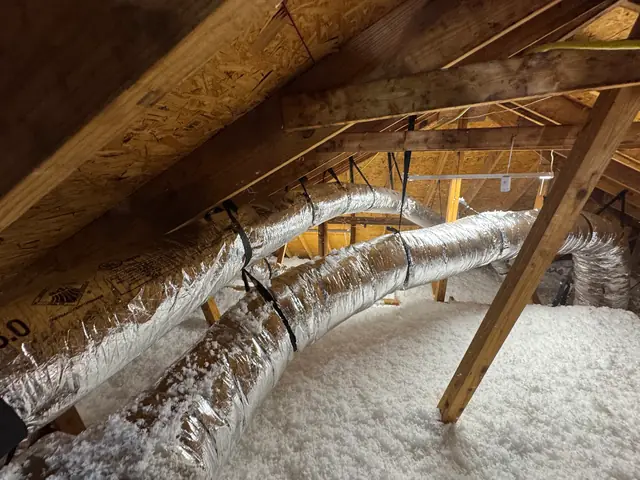
Most homeowners pay attention to the equipment -- the outdoor condenser, the indoor air handler, the thermostat -- and rarely think about the duct system that connects them to the living space. In Southeast Texas, this is a costly oversight. Attic temperatures in Montgomery County regularly reach 140 to 150 degrees on summer afternoons. Ducts running through that space are constantly fighting to keep conditioned air cold long enough to reach the registers, and any leak or deterioration makes that fight worse.
Signs of duct problems you can notice from inside the house
- Uneven temperatures between rooms. One bedroom consistently hotter or colder than the rest of the house often points to a duct issue on that branch, not a problem with the main unit.
- Weak airflow at specific registers. If you hold your hand near a register and feel noticeably less airflow than at other registers on the same system, that run of duct may be disconnected, kinked, or heavily leaking.
- Higher than expected electricity bills. The energy cost of running conditioned air into an unconditioned attic instead of into the living space is real and measurable.
- Visible dust streaks around registers. Leaky ducts pulling in attic air before it reaches a register will often leave a dusty ring on the ceiling or wall around the vent.
- Rattling or popping sounds from the ceiling when the system starts or stops. Some noise is normal thermal expansion, but persistent rattling suggests loose duct joints.
Why Texas attics are especially hard on ductwork
Flexible duct -- the kind most commonly used in residential construction in this region -- consists of an inner liner, insulation, and an outer jacket. Constant thermal cycling between the 140-degree attic air and the cold conditioned air moving through the duct stresses every connection point. In homes built in the 1980s and 1990s, the duct insulation is often fiberglass batts with an R-value of 6 to 8. Current energy code in Texas requires R-8 for attic ductwork, and many older homes never had it. Under-insulated ducts lose cooling to the surrounding attic before the air ever reaches a register.
The air quality connection
Duct leaks on the return side of the system -- the ducts pulling air back to the air handler -- are particularly worth addressing. A return duct with a gap or loose connection draws air from the attic or wall cavities. In a Houston-area home, that means pulling in hot, humid, potentially moldy attic air and passing it over the evaporator coil, then distributing it through the living space. Duct sealing is one of the most effective indoor air quality improvements available, and it pays back in energy savings at the same time.
What an inspection involves
A proper duct inspection involves both a visual examination of accessible ductwork and, in cases where problems are suspected, a duct blower test that pressurizes the system and measures total leakage. Air Woodlands A/C and Heating handles ductwork inspection, sealing, and replacement throughout The Woodlands area. Homes built before 1995 in particular often benefit from at least an inspection, because the duct tape and mastic methods of that era have had decades of Texas heat to work on. Sealing obvious joints and gaps is a relatively low-cost repair that consistently improves both comfort and utility bills.
Air Woodlands A/C and Heating. (281) 367-8135
Call (281) 367-8135More articles
Repair or Replace? How to Decide When Your AC Struggles in a Texas Summer
The right answer depends on age, repair cost, and what the next three Houston summers will cost you to run it.
Humidity Is Half the Problem: What HVAC Owners in The Woodlands Need to Know
In a climate where July dew points regularly hit the low 70s, your air conditioner is a dehumidifier as much as it is a cooling machine.