Humidity Is Half the Problem: What HVAC Owners in The Woodlands Need to Know
In a climate where July dew points regularly hit the low 70s, your air conditioner is a dehumidifier as much as it is a cooling machine.
August 26, 2026 · 2 min read
Most homeowners think of air conditioning as a temperature problem. You set a thermostat, the unit blows cold air, and the house cools down. But in the greater Houston area and The Woodlands corridor, humidity is often the bigger comfort factor. When relative humidity inside your home climbs above 60 percent, 74 degrees can feel muggy and uncomfortable. At 75 percent humidity, you can have mold growth risk on surfaces even with a functional air conditioner.
How your AC removes moisture
Refrigerant-based air conditioning removes humidity as a side effect of cooling. Warm, humid air passes over the cold evaporator coil; moisture condenses on the coil and drains out through the condensate line. A properly sized, properly functioning system does this continuously while it runs. The problem is that several common failure points disrupt moisture removal without obviously affecting temperature.
Signs your system is not removing humidity effectively
- The house feels clammy or sticky even though the thermostat reads your target temperature.
- You notice condensation on windows or cold surfaces inside the home during summer.
- There is a musty or earthy smell that does not go away after cleaning -- this is often early mold in the ductwork or on the evaporator coil.
- Your indoor humidity gauge (if you have one) reads above 55 to 60 percent consistently while the AC is running.
- The condensate drain pan under the air handler has standing water or visible algae buildup.
Oversizing is a common cause
A unit that is too large for the space it serves will cool the air quickly and then shut off before the full dehumidification cycle completes. This is called short cycling, and it is one of the most common reasons newer systems still leave a home feeling humid. Proper Manual J load calculation at installation time matters enormously in a climate like Montgomery County's, where latent heat load (the energy required to remove moisture) is a large portion of the total cooling demand.
What you can do
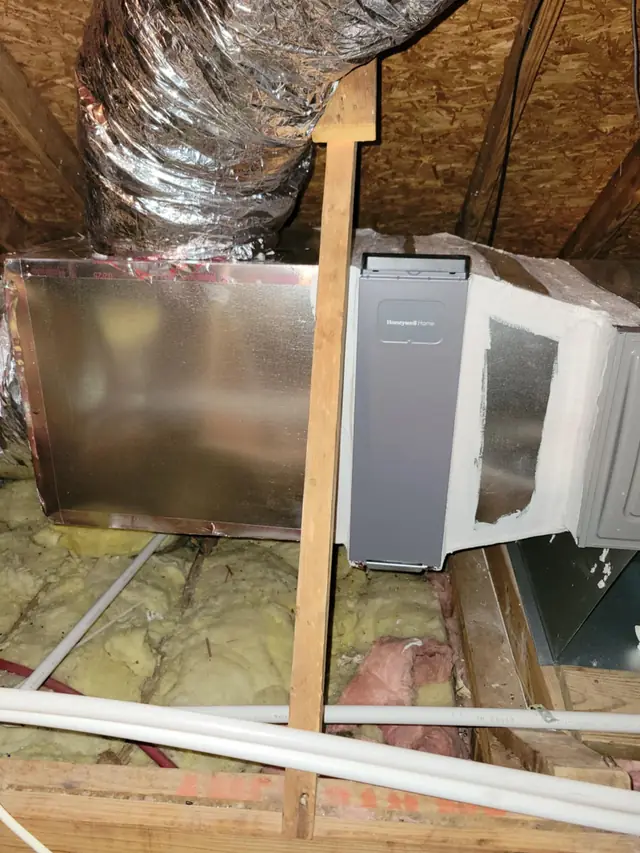
For most homes, keeping the fan set to AUTO rather than ON is a simple first step. When the fan runs continuously, it can re-evaporate moisture off the coil and push it back into the living space. AUTO means the fan only runs during active cooling cycles, giving moisture time to drain properly. A whole-home dehumidifier installed on the air handler is a meaningful upgrade for homes that consistently struggle in the humid months of April through October. It runs independently of the cooling cycle and can hold interior humidity in the 45-to-55 percent range that is comfortable and discourages mold.
Annual coil cleaning
A dirty evaporator coil loses its ability to condense moisture efficiently. In The Woodlands area, where systems run much of the year, annual coil cleaning is a practical maintenance item rather than a luxury. Air Woodlands A/C and Heating includes coil inspection as part of its seasonal tune-up service, which is worth scheduling in spring before the heavy-humidity months arrive.
Air Woodlands A/C and Heating. (281) 367-8135
Call (281) 367-8135More articles
Repair or Replace? How to Decide When Your AC Struggles in a Texas Summer
The right answer depends on age, repair cost, and what the next three Houston summers will cost you to run it.
Mini Split Systems: When They Make Sense and When They Do Not
The garage conversion, the sunroom addition, the bonus room over the garage -- these are the spaces where a mini split earns its cost.